
Search News
Industry Portal
Hot Articles
- Research and Markets Releases Global Bio-Based Structural Wood Adhesives ReportBio-based structural wood adhesives could reach $1.65 billion by 2030. Explore the market forecast and what buyers should verify before specifying products.
- How to read a bolt preload relaxation benchmark chartRead a preload relaxation benchmark chart with confidence. Learn to compare clamp force, test conditions, and retention curves for better joint decisions.
- How to assess batch consistency from a silicone sealants supplierAssess a silicone sealants supplier with practical checks for batch consistency, traceability, cure performance, and adhesion. Reduce rework and buy with confidence.
How Dual-Glue-Pot Edge Banders Limit Adhesive Cross-Contamination
Time
Click Count
Adhesive Contamination Is Often a Changeover Problem
Edge banding defects are frequently blamed on the panel, tape, or adhesive formulation, yet the root cause may sit inside the glue application system. When one adhesive type, color, or condition is carried into the next production run, the result can be visible glue lines, inconsistent wetting, altered bead behavior, reduced bond reliability, or extended cleaning time. These effects are especially problematic for shops processing a mix of light and dark décors, different edge-band materials, or adhesives with different temperature and viscosity requirements.
A dual-glue-pot edge bander addresses this issue by creating separate adhesive paths for different production needs. Rather than draining and cleaning one pot before every adhesive change, operators can keep two adhesive systems prepared for distinct jobs. The practical objective is not simply faster switching. It is to reduce the amount of residual adhesive that can enter a run where it does not belong.
For technical evaluators, the important distinction is between a machine with two pots and a machine with two genuinely controlled glue circuits. The number of pots alone does not determine contamination risk. Separation must be considered across melting, transport, application, cleaning, and maintenance procedures.
What Cross-Contamination Looks Like at the Edge
Adhesive cross-contamination occurs when residue from a previous adhesive run enters the glue line of the next run. It may involve a different adhesive color, a different polymer chemistry, degraded material from a prolonged heat cycle, cleaning residue, or fragments from old adhesive deposits. In many workshops, contamination is intermittent rather than continuous, which makes diagnosis harder. A machine may produce acceptable parts after start-up, then show defects during a material change, a long stop, or a rapid switch between contrasting colors.
Common production symptoms include:
- Dark adhesive shadows appearing under light-colored edge banding.
- Light adhesive residue becoming visible beside dark PVC, ABS, acrylic, veneer, or laminate edges.
- Variable glue squeeze-out from one panel to the next.
- Stringing or smearing that increases trimming and scraping work.
- Changes in bond appearance near the beginning of a run after a product change.
- Glue-line inconsistency caused by partially degraded adhesive remaining in a heated path.
Visual contamination is not always a bond-strength failure, and an apparently clean glue line does not automatically confirm a stable bonding process. The risk depends on the adhesive combination, application temperature, edge band material, substrate condition, feed speed, panel geometry, and the amount of residual material present. Still, visible carry-over is often an early warning that the process lacks adequate segregation or cleaning discipline.
A single-pot machine can be suitable for stable, high-volume work using one adhesive family and limited décor variation. Its limitation becomes clearer when production alternates between white and dark panels, switches between EVA and polyurethane-based systems, or needs different adhesive settings for different edge materials. In those conditions, each changeover creates a decision: accept some residual carry-over, stop for a full cleaning cycle, or maintain separate equipment.
How Two Glue Pots Create Separation
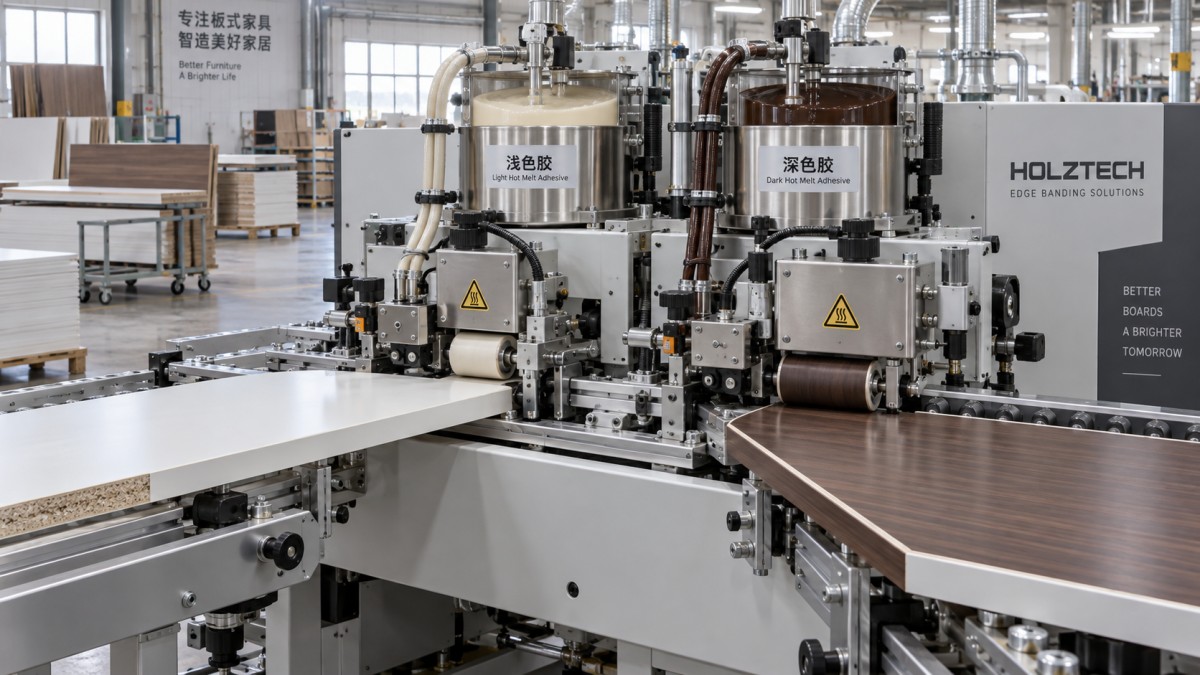
At a basic level, a dual-pot arrangement allows one pot to remain assigned to one adhesive while the second is assigned to another. A common use is one pot for light or transparent adhesive and another for darker adhesive. Another is to dedicate the systems to different adhesive chemistries or working conditions, subject to the machine design and adhesive supplier guidance.
The contamination-control benefit comes from avoiding repeated displacement of one adhesive with another inside the same heated pot. When adhesive is changed in a single-pot arrangement, residue can remain on the tank wall, melting grid, pump components, hoses, application roller, scraper system, and nearby cleaning surfaces. Even a careful drain-down may not remove material that has cooled in dead zones or adhered to internal surfaces.
With two dedicated systems, each adhesive can remain in its assigned circuit. The production change becomes a selection between prepared paths rather than a full adhesive replacement. This can reduce the number of times an operator opens the pot, scrapes residue, introduces cleaning material, or manually transfers adhesive. Those interventions are precisely where mix-ups and variable cleaning quality tend to occur.
However, separation is only as strong as the shared components permit. If two pots feed a common hose, common nozzle, common application roller, or common recirculation chamber, the system may still require a controlled purge before the new adhesive reaches the workpiece. A dual-pot machine should therefore be assessed as a fluid path, not as two containers mounted on one frame.
Where residual adhesive can remain
Technical reviews should map the adhesive route from granule loading to the panel edge. Areas that deserve attention include the melt tank, pump or feed mechanism, transfer hose, valve block, application roller, doctor blade, scraper, glue return channel, and cleaning devices. In some arrangements, the pot itself is well separated but the final application zone is shared. That may be acceptable for two similar adhesives used in the same color family, but it calls for more control where color contrast or chemistry differences are significant.
The purpose of evaluating the dual-glue-system edge bander configuration is to determine how the machine handles this full path: whether the glue circuits are independently managed, what components are common, and what cleaning or purging sequence is required before a product transition.
Color Separation and Chemistry Separation Are Different Tasks
Keeping white and dark adhesives apart is largely an appearance-control issue, although excessive residue can also affect application behavior. Keeping different adhesive chemistries apart is more demanding. Adhesive formulations can differ in softening behavior, viscosity response, open time, application temperature, and compatibility with substrates or edge materials. A system that is satisfactory for color switching should not automatically be assumed suitable for alternating between adhesive families.
For example, a production team may use conventional EVA hot melt for general cabinet components and reserve another adhesive system for moisture-prone parts, heat-exposed applications, or difficult edge materials. The process evaluation must then consider whether both adhesives can operate within the equipment’s heating, pumping, and application capabilities. It must also establish whether any common section can be cleaned sufficiently between runs.
Temperature Control Also Affects Contamination Risk
Adhesive residue becomes harder to manage when thermal conditions vary. Material held at excessive temperature for too long may darken, thicken, form skin, or leave deposits in the system. Material applied below its intended processing range may not wet the panel edge or edge band consistently. In either case, operators can misinterpret the issue as poor adhesive selection when it is actually related to retained material or unstable heating.
Separate pots can support more disciplined temperature management because each adhesive may remain associated with its own operating setpoint and preparation routine. That advantage depends on whether the machine provides practical control and whether operators follow adhesive supplier instructions. A dual-pot layout does not remove the need to manage standby temperature, shutdown behavior, heat-up time, or the condition of adhesive left in the pot after an interrupted shift.
Temperature readings should also be interpreted carefully. A display setpoint is not necessarily the same as adhesive temperature at the application interface. Evaluators should ask where temperature is measured, whether the adhesive path is heated beyond the pot, and how the system responds after idle periods. The relevant question is whether the adhesive reaches the panel in a consistent state, not simply whether a target number appears on the control screen.
Machine Design Details That Matter During Evaluation
When comparing dual-glue-pot machines, a technical review should go beyond general descriptions such as “two colors” or “fast changeover.” The following points help separate a useful contamination-control design from a nominal dual-pot arrangement.
- Dedicated versus shared components: Identify exactly which parts belong to each glue circuit and which components remain common.
- Pot accessibility: A pot that is difficult to inspect or clean can accumulate degraded adhesive and make preventive maintenance inconsistent.
- Selection method: The switch between systems should be clear enough to reduce the chance of an operator applying the wrong adhesive to a batch.
- Purge behavior: If a shared final path exists, determine how much material must be purged and how the purge is confirmed before production resumes.
- Application unit cleaning: Scrapers, doctor blades, rollers, and surrounding guards should be accessible without creating excessive downtime or safety exposure.
- Recipe discipline: The glue system should fit the broader process recipe, including edge-band type, panel material, feed rate, pressure settings, and trimming sequence.
- Material identification: Clear labeling of adhesive containers, pot assignments, and cleaning materials reduces avoidable human error.
Maintenance access is sometimes underestimated during procurement. A well-designed glue circuit can still become a source of contamination if the crew cannot inspect buildup during normal preventive maintenance. Technical teams should consider the time and skill required to remove residue from application components, as well as the availability of documented cleaning instructions for the intended adhesive types.
Validating the System With Production-Relevant Trials
A meaningful acceptance trial should resemble actual production rather than a short demonstration with one panel type. The best test sequence usually includes a difficult transition: dark to light adhesive, light to dark adhesive, or one edge material to another with different visual sensitivity. The assessment should inspect the first panels after switching, not only the parts produced after the machine has stabilized.
Evaluators can define a practical trial protocol around several observations:
- Run the first adhesive under normal production settings and inspect the glue line, trimming result, and squeeze-out condition.
- Switch to the second prepared glue system using the standard operator procedure.
- Record whether a purge is required, what material is removed, and how operators decide the new adhesive has reached the application point.
- Inspect the initial panels after switching for color traces, adhesive strings, gaps, residue, or inconsistent bead width.
- Repeat the transition after an idle period, because settled or thermally aged residue may behave differently from material in continuous use.
Bond assessment should be appropriate to the end use and should follow the adhesive supplier’s recommended conditioning and test method. A visual check at the machine is useful, but it cannot replace a defined quality procedure where bonded components will face heat, humidity, handling, or downstream machining.
Operational Discipline Determines the Remaining Risk
Dual glue pots reduce one major source of contamination: repeatedly replacing adhesive inside a single shared reservoir. They do not prevent contamination caused by incorrect loading, poorly labeled material, dirty scraper assemblies, mixed cleaning tools, or skipped purge steps. The most reliable results come from pairing machine design with a simple operating standard.
That standard can assign each pot a fixed adhesive identity, specify allowable temperature ranges from the adhesive documentation, define cleaning responsibilities, and require first-off inspection after every glue-system change. Where operators work across shifts, a short log of adhesive used, pot condition, purge activity, and observed defects can reveal whether contamination is linked to a particular transition or maintenance interval.
The strongest reason to specify a dual-glue-pot edge bander is not that two pots automatically eliminate defects. It is that they give the production team a more controllable process boundary. For facilities handling frequent adhesive changes, visually demanding panels, or mixed edge-band programs, that boundary can make troubleshooting more direct, cleaning more targeted, and changeovers less dependent on the condition of one shared glue circuit.
Recommended News
Quarterly Executive Summaries Delivered Directly.
Join 50,000+ industry leaders who receive our proprietary market analysis and policy outlooks before they hit the public library.