
Search News
Industry Portal
Hot Articles
- Research and Markets Releases Global Bio-Based Structural Wood Adhesives ReportBio-based structural wood adhesives could reach $1.65 billion by 2030. Explore the market forecast and what buyers should verify before specifying products.
- How to read a bolt preload relaxation benchmark chartRead a preload relaxation benchmark chart with confidence. Learn to compare clamp force, test conditions, and retention curves for better joint decisions.
- How to assess batch consistency from a silicone sealants supplierAssess a silicone sealants supplier with practical checks for batch consistency, traceability, cure performance, and adhesion. Reduce rework and buy with confidence.
XECSS: How to Identify the Right Structural Repair Solution for Site Conditions
Time
Click Count
A repair method is only “right” when it restores the required performance under the conditions that caused, or will continue to cause, deterioration. A visually successful patch can still be a poor structural decision if it leaves an active corrosion mechanism, a changing load path, inadequate substrate capacity, or an unverified connection between the repair and the existing structure.
The XECSS approach treats structural repair as a site-condition decision rather than a material-selection exercise. It starts with a practical question: what must this asset safely do after repair, under its actual loading, exposure, access, and compliance constraints? The answer determines whether a localized repair is sufficient, whether strengthening is required, or whether repair should be deferred in favor of partial replacement, load restriction, or a broader rehabilitation scope.
Visible damage is evidence, not the design basis
Cracking, spalling, corrosion staining, distortion, delamination, water ingress, and failed joints are observable symptoms. They do not, by themselves, identify the governing defect. The same crack pattern may result from restrained shrinkage, thermal cycling, settlement, overload, reinforcement corrosion, fatigue, seismic displacement, or incompatible prior repairs. Each mechanism demands a different response.
A crack injection system, for example, may restore continuity in dry, dormant concrete cracking where structural bonding is required. It is not an appropriate answer where movement remains active, moisture prevents reliable bond development, or reinforcement corrosion is driving crack propagation from within the member. In those cases, injection without controlling the underlying mechanism can conceal deterioration and complicate later inspection.
Before selecting materials or issuing a repair package, the project record should establish:
- the affected structural element and its role in the load path;
- the likely deterioration or damage mechanism;
- the extent of damage beyond visible boundaries;
- present and anticipated service loads;
- the residual capacity of the existing substrate or connection;
- environmental exposure during construction and in service; and
- the consequences if the repair underperforms.
This distinction is particularly important where a defect occurs near supports, beam-column joints, anchorage zones, penetrations, fatigue-sensitive details, expansion joints, or interfaces between old and new materials. Damage in these locations may affect force transfer even when the visible area is small.
Classify the repair objective before comparing solutions
Repair scopes are often weakened by mixing several objectives under one generic phrase such as “restore damaged concrete” or “repair corroded steel.” The required intervention becomes clearer when the objective is explicitly classified.
Protective repair limits the entry of water, chlorides, chemicals, or other aggressive agents. Coatings, sealers, membranes, joint systems, and corrosion-control measures may be central to this objective. Protection can be essential to durability, but it does not automatically restore lost structural capacity.
Section restoration replaces missing or unsound material and reinstates geometry. This may include concrete removal and replacement, grout placement, weld restoration, or localized plate replacement. Its suitability depends on whether the remaining substrate can transfer stresses into the restored area.
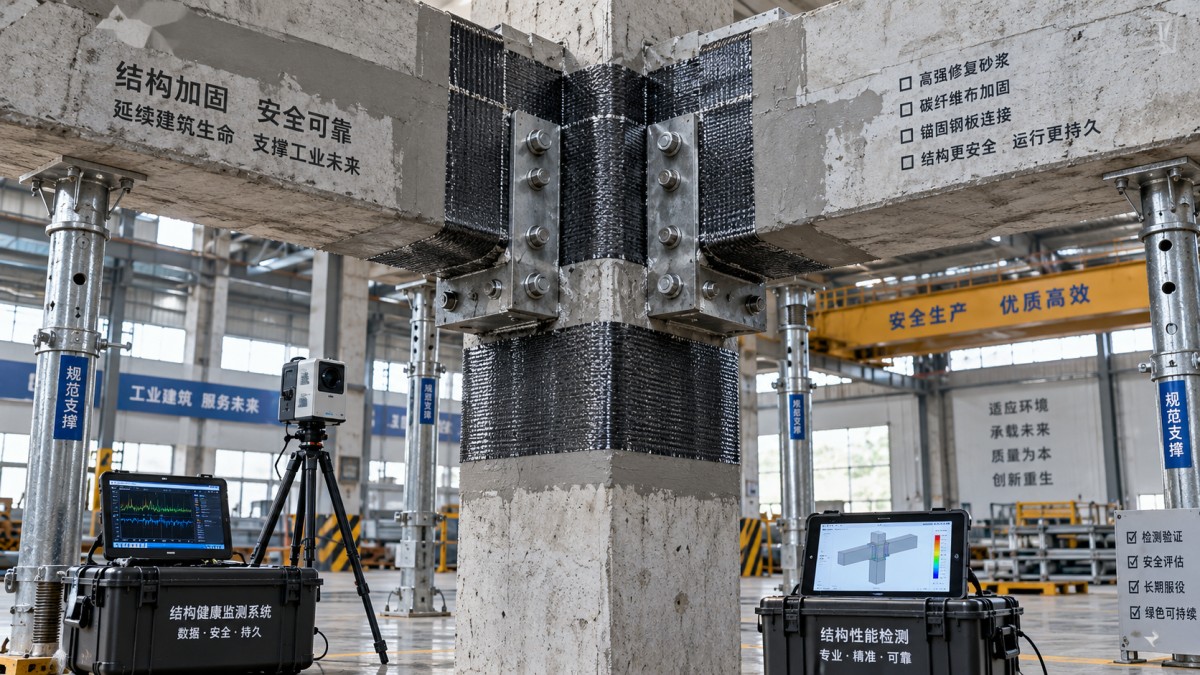
Structural strengthening increases capacity, stiffness, confinement, or ductility beyond the residual state of the damaged member. Steel plates, external post-tensioning, reinforced concrete jacketing, section enlargement, or fiber-reinforced polymer systems can serve this purpose, but only when their load-transfer details are designed for the actual force demand.
Movement accommodation addresses displacement rather than simply resisting it. Expansion joints, flexible seals, sliding details, seismic isolation components, and appropriately detailed interfaces may be needed where thermal, settlement, vibration, or seismic movement remains part of service conditions.
A single scope can contain more than one objective. A marine concrete repair may require removal of chloride-contaminated material, reinforcement treatment, section restoration, a protective system, and revised drainage. Treating that package as a simple patch repair leaves too much to contractor interpretation.
Start with the existing structure’s ability to accept a repair
The repair material is rarely the weakest link in a product data sheet. The more consequential issue is whether the existing material can accept the repair forces without failing adjacent to the repair zone.
For concrete, this means assessing more than nominal compressive strength. Bond-critical repairs depend on substrate soundness, tensile pull-off capacity where relevant, internal cracking, reinforcement condition, cover depth, moisture state, and the quality of the prepared surface. A high-strength repair mortar placed over weak, carbonated, microcracked, or contaminated concrete may create a durable-looking surface over an unreliable interface.
For steel structures, the assessment should identify remaining thickness, pitting severity, crack indications, weld condition, distortion, coating breakdown, and the possibility of fatigue loading. Adding a welded plate to a fatigued member is not automatically benign: weld geometry, residual stress, access for welding, heat input, and the new stress concentration pattern may all affect the detail’s behavior.
For masonry, timber, composite assemblies, and mixed-material interfaces, compatibility is equally important. Moisture transport, differential stiffness, thermal expansion, fastener pull-out resistance, and hidden voids can govern performance more than the nominal strength of the selected repair product.
XECSS-based evaluation therefore separates the question “Is the new system strong enough?” from the more important question “Can the old structure transfer load into and through the new system for the required service life?”
Load demand determines whether repair becomes strengthening
Structural repair should be checked against the load state expected after handover, not only against the damage observed during inspection. A building may be undergoing a change of use; a bridge may face revised vehicle loading; industrial equipment supports may be exposed to new dynamic loads; and critical facilities may require a higher resilience standard after renovation. These changes can turn a restoration project into a strengthening project.
The design team needs a clear basis for dead load, imposed load, wind, thermal effects, vibration, accidental actions, and seismic demand where applicable. Temporary construction loads also matter. Removing deteriorated material, drilling anchors, unloading a member, jacking, welding, or installing a jacket can alter stress distribution before the permanent repair is complete.
External reinforcement systems illustrate the issue. Carbon-fiber-reinforced polymer (CFRP) can be highly effective for flexural, shear, or confinement applications when fiber orientation, anchorage, substrate preparation, adhesive behavior, edge detailing, and fire protection are addressed. It is not a universal substitute for section enlargement or steel reinforcement. Its contribution may be limited by debonding, insufficient development length, high service temperatures, ultraviolet exposure, impact risk, or the need for fire-resistance performance beyond that of the resin system.
Likewise, concrete jacketing may add confinement and section capacity, but it can increase dead load, reduce clearance, interfere with services, and require reliable shear transfer across the old-to-new interface. The “stronger” option is not necessarily the lower-risk option when it introduces construction constraints or changes seismic mass and stiffness.
Environmental exposure should influence the repair system, not just the coating specification
Environmental conditions affect the entire repair assembly: substrate, reinforcement, anchors, adhesive, grout, seal, protective layer, and interface. A repair designed for a dry interior location cannot simply be transferred to a chloride-exposed parking structure, splash-zone asset, chemical processing area, freeze-thaw environment, or high-temperature enclosure.
Moisture deserves particular attention. Moisture can be the agent of corrosion, freeze-thaw damage, sulfate attack, alkali-related distress, adhesive failure, and leakage-driven degradation. It can also determine whether installation is feasible. Many bonded systems require controlled surface moisture and temperature conditions; some repair mortars require curing regimes that are difficult to maintain in exposed or operational facilities.
Thermal range is another overlooked variable. Differential movement between an existing substrate and a stiff repair layer can generate interface stress. In structures with frequent temperature cycling, long restrained lengths, or significant solar exposure, jointing and movement compatibility may be more valuable than maximizing material strength.
Where electromagnetic shielding, sensitive electronic infrastructure, or specialized protective enclosures are involved, repair decisions should also preserve continuity of conductive paths, seals, grounding arrangements, and penetrations. A structurally competent intervention can still compromise functional shielding if it interrupts the broader protection system.
Constructability is part of structural suitability
A repair detail that cannot be prepared, installed, cured, inspected, and maintained under site conditions is not a viable solution. This is not a secondary procurement concern; it is a performance issue.
Access constraints may limit concrete removal equipment, lifting operations, weld quality, surface preparation, or the ability to achieve full fiber wrap coverage. Live facilities may restrict dust, noise, hot work, shutdown duration, and cure time. Marine, underground, elevated, or confined-space work may make a theoretically appropriate method disproportionately difficult to control.
Project teams should test the proposed method against the actual work sequence:
- Can damaged material be removed without destabilizing the member?
- Can the specified surface profile and cleanliness be achieved consistently?
- Can reinforcement, anchors, plates, or fibers be installed with the required development and edge distances?
- Can temperature, moisture, mixing, placement, and curing conditions be controlled?
- Can critical interfaces be inspected before they become concealed?
- Is there a realistic contingency if hidden deterioration exceeds the survey extent?
These questions often reveal why a repair that appears economical in a bill of quantities becomes expensive in execution. A simpler system with more forgiving installation tolerances may offer lower whole-project risk than a high-performance system that depends on near-laboratory site control.
Compliance is not satisfied by citing a material standard
Repair products, repair designs, and completed repairs are governed by different forms of evidence. A product’s test report or declaration of conformity may demonstrate specified material properties, but it does not demonstrate that the repair detail meets the governing structural design requirements for a particular asset.
The applicable design code, owner specification, jurisdictional requirements, and asset classification should be established early. For concrete repair work, documents such as ACI 562 or the EN 1504 series may be relevant depending on project location and contractual framework, but they do not replace project-specific engineering assessment. For steelwork, welding and inspection requirements must align with the applicable structural steel code and approved repair procedure. Seismic, fire, durability, and occupational safety obligations may impose additional constraints on the selected system.
Compliance review should therefore cover the whole chain: assessment method, design assumptions, material qualification, installer competence, inspection hold points, acceptance criteria, and post-repair records. A technically sound design can still become difficult to defend if the site record cannot demonstrate that preparation and installation matched the approved method.
Use verification to reduce uncertainty before full deployment
Where the asset is critical, conditions are variable, or the repair relies on bond and anchorage performance, a trial area or mock-up can be more useful than extended debate over product literature. It can confirm whether the substrate preparation method is practical, whether moisture conditions are manageable, whether access permits proper installation, and whether the specified quality tests can be performed without disrupting operations.
Verification should be tied to the actual failure modes. Depending on the system, relevant controls may include sounding and delamination mapping, dimensional checks, cover or thickness measurements, reinforcement condition assessment, pull-off testing where specified, anchor proof testing, weld inspection, curing records, crack monitoring, and confirmation of protective-system continuity. Not every repair needs every test; indiscriminate testing can distract from the interfaces that genuinely govern performance.
The acceptance plan should also define what happens when conditions differ from the design assumptions. Discovery of deeper corrosion, weak substrate, unexpected voids, active leakage, or inaccessible reinforcement should trigger a documented engineering decision rather than an improvised field substitution.
A defensible repair decision links condition, consequence, and service life
The strongest repair specification is not the one with the highest nominal material strength or the most extensive product schedule. It is the one that makes the damage mechanism manageable, restores the required structural function, can be executed under site constraints, and provides evidence that the finished work performs as intended.
XECSS is most useful when it prevents premature commitment to a familiar solution. A patch may be enough when the damage is local, the cause has been removed, and residual capacity is demonstrated. Strengthening may be necessary when capacity, ductility, or load-path reliability is inadequate. Replacement or load restriction may be the more responsible decision when deterioration is widespread, substrate uncertainty is high, or reliable installation cannot be achieved.
That is the practical threshold for selection: not whether a repair system can be applied to the damaged area, but whether the repaired structure can safely and durably meet its defined duty under the conditions it will actually face.
Recommended News
Quarterly Executive Summaries Delivered Directly.
Join 50,000+ industry leaders who receive our proprietary market analysis and policy outlooks before they hit the public library.