
Search News
Industry Portal
Hot Articles
- Research and Markets Releases Global Bio-Based Structural Wood Adhesives ReportBio-based structural wood adhesives could reach $1.65 billion by 2030. Explore the market forecast and what buyers should verify before specifying products.
- How to read a bolt preload relaxation benchmark chartRead a preload relaxation benchmark chart with confidence. Learn to compare clamp force, test conditions, and retention curves for better joint decisions.
- How to assess batch consistency from a silicone sealants supplierAssess a silicone sealants supplier with practical checks for batch consistency, traceability, cure performance, and adhesion. Reduce rework and buy with confidence.
When should leaking hydraulic building shock absorbers be replaced?
Time
Click Count
Leaking hydraulic building shock absorbers should be replaced when fluid loss, physical damage, or failed performance verification makes them unacceptable under the project’s requirements and an approved repair cannot restore that compliance. A surface stain alone does not establish that replacement is necessary. Active dripping, recurring wetness, or leakage accompanied by rod damage or abnormal movement requires prompt engineering assessment rather than routine observation.
The practical distinction is between evidence of oil on the outside and evidence that the device can no longer provide its specified damping response. Neither appearance nor leakage rate alone can resolve that question. The decision must account for the manufacturer’s service limits, the device’s condition, its role in the structural system, and whether repair can be properly tested and documented.
Establish what is leaking before deciding what to replace
“Building shock absorbers” can refer to different hydraulic devices. Fluid viscous dampers dissipate energy during structural movement, while hydraulic lock-up devices or shock transmission units serve a different function. Their inspection criteria and acceptance tests are not interchangeable. Confirm the nameplate, serial number, approved drawings, and operating manual before applying any maintenance rule.
For a fluid viscous damper, resistance depends on fluid passing through a controlled internal flow path as the piston moves. Loss of fluid can affect chamber filling and force response; air entry or internal damage can further change its behavior. The relationship between visible leakage and lost damping capacity is not necessarily proportional. A small external leak does not prove a large performance loss, but it also does not demonstrate acceptable performance.
Oil on the cylinder may originate from a previous service operation, assembly residue, a nearby hydraulic system, or lubrication at an adjacent bearing. Trace the wet area to its source. A stain below a device is evidence to investigate, not proof that the rod seal has failed.
Check the installation position as well. Oil can travel along the cylinder, collect at a bracket, or drip onto a lower component. The lowest wet point may be far from the actual leak.
Distinguish residual staining from recurring leakage
Document the condition before cleaning anything. Record the device identification, leak location, extent of wetting, visible drops, surrounding deposits, and any recent structural event or maintenance activity. Take both close-up photographs and wider views showing the device, connections, and installation position.
Where the manufacturer permits it, clean the external surface with a compatible method and establish a dated baseline. Avoid abrasive cleaning of the piston rod or solvents that could damage seals, coatings, or protective components. Reinspect according to an interval agreed with the manufacturer or responsible engineer, with shorter intervals where recurrence or deterioration is suspected.
The following observations support different maintenance decisions:
There is no universal acceptable number of drops per day for structural hydraulic dampers. A threshold borrowed from an industrial cylinder or vehicle shock absorber is not a valid acceptance criterion. Some designs may permit narrowly defined surface wetting; others require a different response. Use the criteria for the actual device and project.
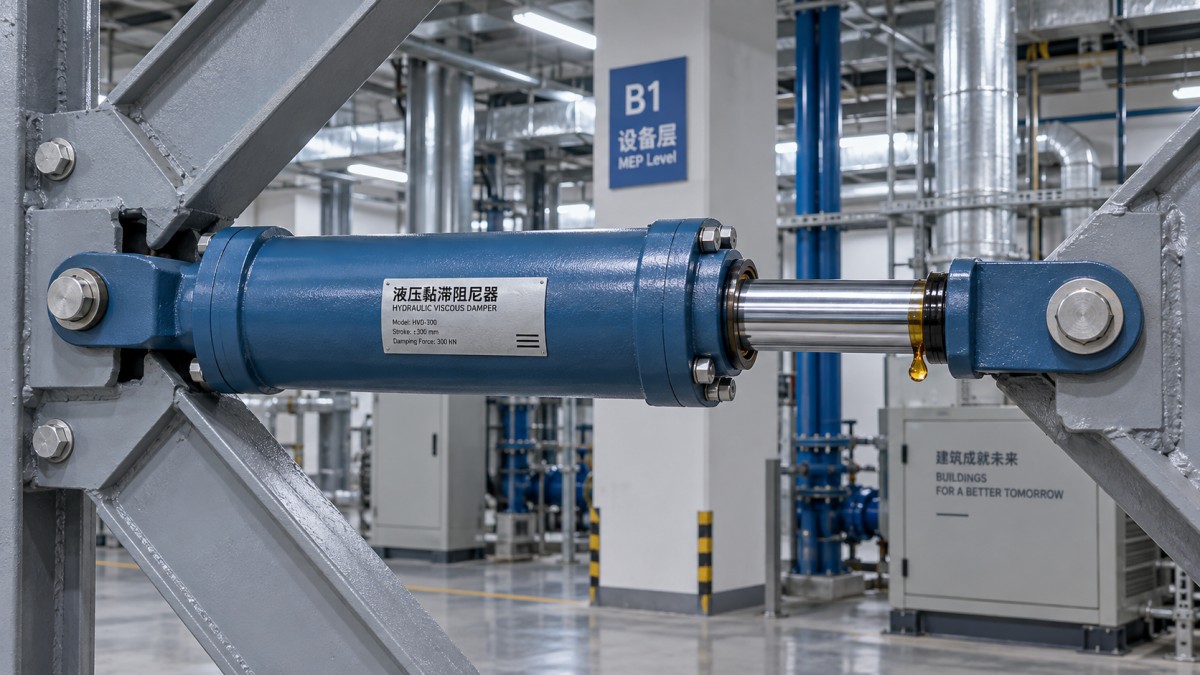
A dry inspection after a period without movement is not conclusive. Leakage may occur only during stroke, temperature changes, or dynamic loading. Do not move the device or impose loads simply to reproduce a leak unless the procedure has been specifically approved.
Conditions that require urgent escalation
Active dripping deserves prompt attention because cumulative loss may be unknown, particularly where inspection access is infrequent. Urgency increases when the leak first appears after an earthquake, impact, fire exposure, or other event that could have exceeded the device’s qualified operating conditions.
Other warning signs include a bent or deeply scored rod, corrosion in the seal travel zone, cracks or deformation in the cylinder or end fittings, displaced pins, loose attachments, and evidence that the damper has reached a stroke limit. Leakage combined with these defects should not be treated as an isolated seal-maintenance issue.
Abnormal noise, jerky movement, or altered structural response may also justify investigation, but none provides a reliable field measurement of remaining damping capacity. Conversely, the absence of obvious movement problems does not clear the device for continued service.
The immediate response should be to notify the responsible structural engineer and manufacturer, control access where necessary, and establish an approved interim plan. A damper can remain integral to the structural load path while leaking. Disconnecting it may change the building’s response or release stored forces. Do not remove pins, loosen pressure-containing parts, or attempt depressurization without an engineered procedure.
Leakage alone does not establish whether a building must be evacuated or can remain fully operational. That determination depends on the structural design, device redundancy, damage extent, and applicable emergency procedures. The condition report should clearly distinguish observed defects from engineering conclusions.
When replacement is the defensible decision
Replacement is appropriate when the device cannot be shown to meet its required performance and condition limits through an approved repair route. Several findings make that decision more direct.
The unit fails relevant performance acceptance criteria. A controlled test may reveal an unacceptable force–velocity response, force–displacement behavior, stroke capability, or other specified characteristic. Where repair is unavailable or cannot restore compliance, replacement is necessary. A visual inspection cannot overrule a failed acceptance test.
Critical parts are damaged beyond approved repair limits. Cylinder distortion, serious rod damage, damaged end connections, or compromised pressure-containing components can make seal replacement insufficient. Repairability must be established from the manufacturer’s limits and engineering review, not from whether a local workshop can physically rework the part.
Leakage persists after an approved repair. Repeated seal failure can indicate rod defects, misalignment, contamination, unsuitable seal materials, or an unresolved internal problem. Another seal change without identifying the cause may reproduce the failure. Replacement may be justified, but the installation cause must also be corrected.
There is no qualified service route. Some devices are sealed or not intended for field rebuilding. If the original design information, approved parts, compatible fluid, or required test capability is unavailable, a repair may not provide adequate evidence of restored performance. An engineering-approved replacement is then more defensible than an undocumented rebuild.
The device exceeds an applicable service restriction. A manufacturer may specify mandatory overhaul or replacement conditions tied to age, cumulative operation, exposure, or event history. Apply those requirements to the identified model. There is no single replacement age that can be assigned to all hydraulic structural dampers.
When manufacturer-approved repair may be acceptable
Repair may be appropriate when leakage is attributable to a serviceable seal or approved connection, critical components remain within tolerance, and the manufacturer provides a qualified restoration process. That process may involve replacing seals, inspecting internal parts, restoring the specified fluid charge, removing trapped air, and verifying performance.
Changing an external seal is not automatically a complete repair. If fluid has escaped, the remaining charge and internal condition must be assessed. Adding oil until the device appears full does not establish correct filling, fluid compatibility, or acceptable damping behavior.
External sealants, unapproved additives, and improvised tightening of seal housings are unsuitable substitutes for a qualified repair. They can conceal the leakage source or alter the device without addressing the defect. Field intervention should remain within the documented service instructions.
The repair decision should also account for removal, transport, testing, and reinstatement time. A repair with a lower workshop cost may leave a critical structural element unavailable longer than a qualified replacement would. Any temporary arrangement must be designed and approved; it cannot be assumed that adjacent dampers will absorb the missing unit’s duty.
Verify damping performance, not just leak tightness
A repaired or replacement device needs evidence relevant to its structural function. A leak-tightness check can confirm the absence of external leakage under specified conditions, but it does not by itself verify damping response across the required operating range.
For a fluid viscous damper, testing may need to address the specified relationship between force and velocity, behavior through the required stroke, and relevant temperature conditions. The exact test scope and acceptance limits should come from the project specification, applicable requirements, and manufacturer-approved procedure. Do not substitute a low-speed manual movement check for qualified performance testing.
The engineer may require inspection or testing of other devices if the defect suggests a shared cause, such as common exposure, installation misalignment, or a service problem affecting a production group. That does not mean every leaking unit requires replacement of the entire set. The scope should follow the evidence and structural consequences.
For a replacement, matching length and nominal force is insufficient. Confirm the damping characteristics, usable stroke, movement allowances, connection geometry, articulation, temperature range, and environmental protection. A physically interchangeable unit with a different dynamic response can alter forces elsewhere in the structure.
Close the maintenance action with traceable evidence
Before removal, record the installed position and orientation, connection condition, and any evidence of misalignment. Preserve the defective unit for examination where useful. Discarding it immediately can eliminate evidence needed to explain why the seal failed and whether the replacement faces the same risk.
The completed record should link the original defect to the repair or replacement decision. Include the manufacturer’s assessment, engineering disposition, device serial numbers, approved work instructions, test reports, installation checks, and authorization to return the system to its intended condition. An invoice or a statement that the leak has stopped is not equivalent to performance acceptance.
After reinstatement, inspect for fresh wetting and confirm that protective components and attachments have been restored correctly. Any follow-up interval should reflect the failure mechanism and approved maintenance plan. A unit replaced because of rod misalignment warrants verification of that alignment, not merely another photograph of a dry cylinder.
The replacement threshold is therefore not “any oil means failure” or “replace only when damping visibly disappears.” It is the point at which documented condition and performance requirements cannot be met through a qualified repair. Residual staining may justify observation; confirmed active leakage requires a technical disposition; damage or unverified performance requires action before the device is accepted as serviceable.
Recommended News
Quarterly Executive Summaries Delivered Directly.
Join 50,000+ industry leaders who receive our proprietary market analysis and policy outlooks before they hit the public library.