Search News
Industry Portal
Hot Articles
- How does duplex coating affect thread fit on high-tensile bolts?Explore how duplex coating fasteners affect thread fit on high-tensile bolts. Learn to control coating buildup, prevent binding, and verify preload for reliable assemblies.
- JX Advanced Metals Launches 100% Recycled Copper Foil for Electromagnetic ShieldingJX Advanced Metals launches 100% recycled copper foil for electromagnetic shielding. Explore a new material option for electronics and sustainable sourcing.
- Using global steel supply chain alerts to assess bolt delivery risksUse global supply chain alerts for steel to assess bolt delivery risks, verify material availability, and choose recovery options. Learn how to protect schedules and control costs.
Selecting structural epoxy for concrete crack injection
Time
Click Count
Maintaining long-term structural durability in modern infrastructure requires precision in structural repair and the selection of advanced engineering materials. When addressing concrete vulnerabilities, selecting the right structural epoxy is paramount for ensuring structural safety and extending the lifecycle of critical assets. As a leader in technical benchmarking for infrastructure materials, G-SCE bridges the gap between high-strength material fabrication and rigorous shielding protocols, including EMI mitigation and seismic protection. From industrial fasteners to specialized resins, project managers must evaluate performance against international standards. This guide provides technical evaluators and decision-makers with the insights needed to navigate complex material choices, ensuring every injection repair aligns with global safety benchmarks for resilient mega-structures.
The Mechanics of Structural Crack Injection and Load Distribution
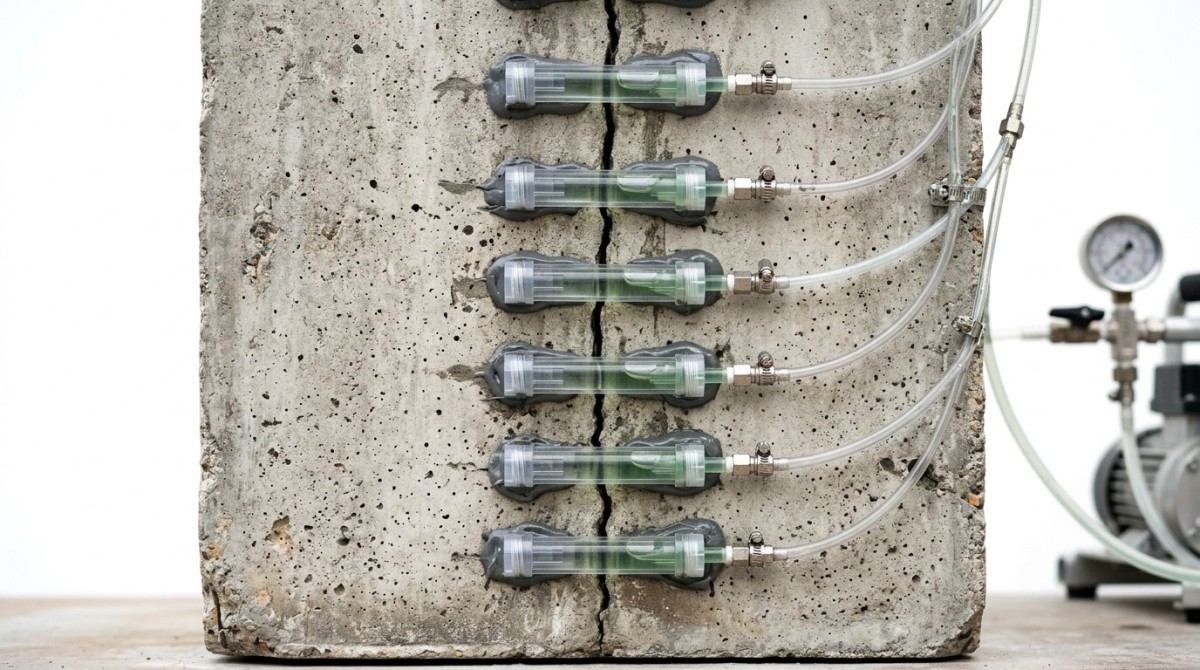
Structural crack injection is more than a simple filling process; it is a sophisticated engineering intervention designed to restore the monolithic integrity of a reinforced concrete element. When a crack appears in a high-stress environment—such as a bridge pier or an aerospace hangar floor—it represents a break in the continuous path of load transfer. Structural epoxy resins are engineered to penetrate these fissures, displacing air and moisture, and bonding the fractured surfaces with a tensile strength that often exceeds that of the parent concrete itself. This restoration is critical for preventing the ingress of corrosive agents like chlorides and carbon dioxide, which can lead to the rapid oxidation of internal steel reinforcements and subsequent structural failure.
Understanding the type of crack is the first step for any technical evaluator. Is the crack dormant, caused by initial shrinkage, or is it active, resulting from ongoing seismic settlement or thermal expansion? For active cracks, a rigid epoxy might cause secondary fracturing nearby, whereas for structural reinforcement, a high-modulus resin is mandatory. At G-SCE, we emphasize that the "Integrity of Infrastructure" relies on selecting a resin that matches the dynamic and static load profiles of the asset. The choice between low-pressure and high-pressure injection methods also hinges on the crack's geometry, which can range from hairline widths of 0.05 mm to significant structural gaps exceeding 6 mm.
Project managers must also consider the rheological properties of the epoxy during the injection phase. The resin must remain fluid enough to travel deep into the structure without premature "gelation," yet it must develop high early strength to minimize downtime. In the context of Global Top 500 engineering projects, where a single hour of facility closure can cost thousands of dollars, the efficiency of the injection material is a direct driver of project ROI. Technical benchmarking of these materials involves assessing their behavior under varied injection pressures, ensuring that the bond line is consistent throughout the entire depth of the structural member, rather than just a surface-level seal.
Finally, the synergy between the epoxy and the surrounding environment is a core focus for quality management. In high-seismic zones, the epoxy must contribute to the overall seismic isolation strategy by ensuring that the repaired joint can withstand the anticipated peak ground acceleration. Furthermore, in facilities where electromagnetic interference (EMI) is a concern, such as data centers or aerospace labs, the structural repair must not compromise the specialized shielding protocols already in place. G-SCE bridges this technical gap by providing benchmarks that align high-strength material performance with the sophisticated safety requirements of next-generation mega-structures.
Technical Parameters: Viscosity, Bond Strength, and Curing Dynamics
The selection process for a structural epoxy requires a deep dive into specific material parameters that dictate its performance in the field. One of the most critical variables is viscosity, which is measured in centipoise (cps). Ultra-low viscosity resins (50 to 200 cps) are designed for gravity-fed repairs or very fine hairline cracks, while medium-viscosity resins (500 to 1,500 cps) are preferred for wider cracks or high-pressure injection where containment is necessary. Selecting a resin with an inappropriate viscosity can lead to "incomplete fill," leaving internal voids that act as stress concentrators, ultimately undermining the repair's structural intent.
Bond strength to concrete, often evaluated through slant-shear tests, is another non-negotiable metric for procurement directors. For a repair to be considered truly structural, the bond strength must typically exceed 10 MPa (1,450 psi) after a 7-day cure at room temperature. However, in mission-critical infrastructure, we often look for resins that provide a bond strength of 15 to 20 MPa to ensure a significant factor of safety. The table below illustrates how different epoxy grades align with specific crack characteristics and application requirements, providing a baseline for technical benchmarking.
The data presented above highlights the necessity of matching material rheology to the physical dimensions of the structural defect. A mismatch, such as using a high-viscosity paste for a fine crack, will result in poor penetration, while using an ultra-low viscosity resin for a wide, open-ended crack may lead to excessive material loss and leakage before the resin can cure. This technical alignment is a core pillar of the G-SCE methodology, ensuring that every material choice is backed by measurable performance data rather than anecdotal evidence.
Curing dynamics also play a vital role, especially in environments with extreme temperatures. Most standard structural epoxies require a substrate temperature between 5°C and 35°C (40°F to 95°F). For cold-weather repairs in Arctic infrastructure or high-temperature applications in industrial smelters, specialized resins must be sourced. These materials are benchmarked against ASTM C881, which classifies epoxies by type, grade, and class, providing a standardized framework for decision-makers to evaluate their suitability for specific climatic and structural conditions.
Environmental Variables and Site-Specific Constraints
Beyond the mechanical properties of the epoxy, the success of a structural injection repair is heavily influenced by site-specific environmental conditions. Moisture is the primary adversary in concrete repair. Standard epoxies are "moisture-sensitive" and will fail to bond if the crack surfaces are damp. However, in infrastructure like dams, sewage treatment plants, or underwater bridge foundations, "moisture-tolerant" or even "underwater-curing" epoxies are required. These specialized resins are formulated to displace water at the molecular level, ensuring a high-strength bond even in saturated conditions.
Chemical exposure is another critical consideration for procurement directors managing industrial or aerospace facilities. Structural epoxies must often resist a variety of aggressive substances, including jet fuels, hydraulic fluids, acids, and alkalis. If the concrete crack is located in a secondary containment area for hazardous materials, the epoxy must be benchmarked for its chemical resistance over a 30-day or even 90-day immersion period. Failure to account for these variables can lead to the resin softening and degrading, necessitating a costly secondary repair and potentially compromising the "Integrity of Infrastructure" during a spill event.
Thermal movement and seismic volatility introduce dynamic stresses that static epoxy repairs must withstand. While structural epoxy is rigid, the lifecycle of a mega-structure involves constant expansion and contraction. G-SCE benchmarks materials against their coefficient of thermal expansion (CTE) to ensure they are compatible with the concrete substrate. If the epoxy's CTE is significantly different from that of the concrete, thermal cycling can induce stresses at the bond line, leading to delamination. For structures in seismic zones, the brittle nature of epoxy is often balanced with Carbon-Fiber-Reinforced Polymers (CFRP) to provide additional ductility and confinement, a multi-layered approach to structural reinforcement.
In specialized sectors like aerospace and telecommunications, electromagnetic shielding (EMI) and specialized protection materials are part of the broader structural conversation. When repairing cracks in shielded enclosures, the structural epoxy must not create a "leak" in the electromagnetic seal. While standard resins are non-conductive, they can be modified with nano-fillers to maintain shielding effectiveness. This intersection of material science and electronics protection is where G-SCE provides unique value, helping technical evaluators navigate the requirements of MIL-SPEC and other high-stringency international standards.
Benchmarking Against International Regulatory Frameworks
For Global Top 500 engineering firms, compliance is not optional; it is the foundation of risk management. Structural epoxy selection must adhere to established international standards such as ASTM C881 (USA), EN 1504-5 (Europe), and ISO 16276. These standards provide a rigorous classification system based on the intended use—whether the epoxy is for bonding hardened concrete to hardened concrete, or for injecting cracks under pressure. By adhering to these benchmarks, project managers can ensure that the selected materials have undergone standardized testing for compressive strength, heat deflection temperature, and linear shrinkage.
Regulatory compliance also extends to the safety and environmental impact of the materials used. Modern infrastructure projects increasingly demand low-VOC (Volatile Organic Compound) and BPA-free formulations to meet LEED and other sustainability certifications. In technical benchmarking, we look for materials that offer 100% solids content, which ensures that no solvents evaporate during the curing process. This prevents the formation of microscopic pinholes in the resin, which could otherwise become pathways for moisture and corrosive ions. The following table highlights key international standards and the specific metrics they regulate for structural bonding agents.
As indicated in the table, different regions utilize specific designations, yet the core focus remains on adhesion and long-term durability. For a project managing global assets, the ability to translate between these standards is essential. G-SCE acts as a repository for this technical intelligence, allowing a Procurement Director in Singapore to confidently source a material that meets Eurocode 2 requirements for a project in Germany. This cross-border benchmarking reduces technical risk and ensures that material procurement is aligned with the most stringent global safety protocols.
Finally, quality control (QC) and safety management personnel must ensure that the epoxy used has been batch-tested and carries a valid Certificate of Analysis (COA). In the aerospace and high-strength fastening sectors, traceability is paramount. Every gallon of structural epoxy should be traceable back to its production lot, with documented results for its compressive strength (usually required to be >50 MPa or 7,250 psi) and tensile elongation (typically 1% to 3%). These metrics are not just numbers; they are the indicators of whether the repair will survive the design life of the structure, which for modern mega-projects is often 100 years or more.
Best Practices for Implementation and Field Quality Control
Even the most advanced structural epoxy will fail if the implementation process is flawed. The first step in any successful injection project is meticulous surface preparation. All dust, grease, and loose concrete must be removed from the crack, often using compressed air (oil-free) or high-pressure water blasting. For technical evaluators, the presence of contaminants is a leading cause of bond failure. Once the crack is clean, injection ports must be strategically placed. The spacing of these ports is typically equal to the thickness of the concrete member—for example, if a wall is 300 mm thick, ports should be spaced every 300 mm to ensure complete penetration from one port to the next.
The injection sequence must follow a "bottom-up" approach for vertical cracks and a "one-end-to-the-other" approach for horizontal ones. This ensures that air is pushed out ahead of the advancing resin, preventing air pockets. Quality control personnel should monitor the injection pressure carefully; excessive pressure can cause "crack propagation" or "blowouts" of the surface seal, while insufficient pressure will lead to incomplete filling. For deep cracks in mass concrete, such as dam walls, the use of automated injection equipment with real-time flow and pressure monitoring is highly recommended to provide a digital "birth certificate" for the repair.
Post-injection verification is the final stage of the quality management cycle. While non-destructive testing (NDT) methods like ultrasonic pulse velocity can provide an indication of the repair's success, the gold standard remains core sampling. Extracting a 50 mm diameter core through the injected crack allows for visual inspection of the epoxy penetration and laboratory testing of the bond strength. If the core breaks in the concrete rather than at the epoxy bond line, the repair is considered successful. G-SCE advocates for a minimum of one core sample for every 15 to 30 meters of injected crack to ensure statistical confidence in the structural restoration.
Frequently Asked Questions and Strategic Procurement Insights
How long does a structural epoxy injection repair typically last?
When properly selected and applied, a structural epoxy injection repair is designed to be permanent. If the underlying cause of the cracking (such as a one-time settlement or overloaded event) has been addressed, the epoxy should last for the remaining lifecycle of the structure, which is often 50 to 100 years. Regular inspections are still required to ensure no new stresses have caused secondary cracking in adjacent areas.
What are the common pitfalls in B2B procurement of structural resins?
The most common pitfall is prioritizing unit cost over "cost-in-place" and long-term performance. Inexpensive epoxies often have higher shrinkage rates or lower bond strengths, leading to premature failure and the need for re-repair. Procurement directors should look for "system solutions" that include technical support, site training for operators, and clear documentation of compliance with international standards like ASTM C881.
Can epoxy be used for cracks in seismic isolation units?
Structural epoxy is excellent for repairing the concrete components surrounding seismic isolation units, such as lead-rubber bearings. However, because epoxy is inherently rigid, it should not be used in joints intended to move. For those areas, flexible expansion materials or specialized seismic isolation units are required. G-SCE specializes in benchmarking both rigid and flexible high-performance assets to ensure comprehensive structural safety.
What is the typical lead time for specialized structural epoxies?
Standard structural epoxies are usually available within 3 to 7 business days. However, specialized resins—such as those requiring EMI shielding properties, extreme temperature resistance, or underwater-curing capabilities—may have a lead time of 2 to 4 weeks. Early engagement with a technical benchmarking hub like G-SCE can help project managers forecast these timelines and avoid critical path delays in mega-structure construction.
Summary and Strategic Direction for Infrastructure Integrity
Selecting the appropriate structural epoxy for concrete crack injection is a critical decision that impacts the safety, durability, and financial value of global infrastructure assets. By focusing on technical parameters such as viscosity and bond strength, and aligning these with international regulatory frameworks, decision-makers can mitigate the risks associated with structural failure. G-SCE remains committed to providing the technical benchmarking and intelligence necessary for the world's most demanding engineering projects, from seismic-resistant skyscrapers to high-security aerospace facilities. We bridge the gap between material fabrication and real-world application, ensuring that the "Integrity of Infrastructure" is maintained against the challenges of the 21st century.
For structural engineers and project managers seeking to optimize their repair protocols, the path forward involves data-driven selection and rigorous field execution. Whether you are managing a fleet of bridges or a single high-tech facility, the integration of specialized reinforcement and repair materials is the key to resilience. To learn more about our technical benchmarking services or to receive a customized material evaluation for your next project, we invite you to consult with our experts. Let G-SCE help you navigate the complexities of structural integrity and safety shielding. Contact us today to get a customized solution for your infrastructure repair needs.
- High-Strength Fastening
- Seismic Isolation
- EMI Shielding
- Infrastructure Integrity
- Structural Reinforcement
- Specialized Protection Materials
- Critical Infrastructure
- Material Fabrication
- Structural Repair
- Shielding Protocols
- Engineering Materials
- Structural Safety
- Industrial Fasteners
- Seismic Protection
- EMI Mitigation
- Infrastructure Materials
- Structural Durability
Recommended News
Quarterly Executive Summaries Delivered Directly.
Join 50,000+ industry leaders who receive our proprietary market analysis and policy outlooks before they hit the public library.